24 de marzo de 1567 y la Virgen de Cortes: una fecha pequeña que ayuda a entender toda una comarca
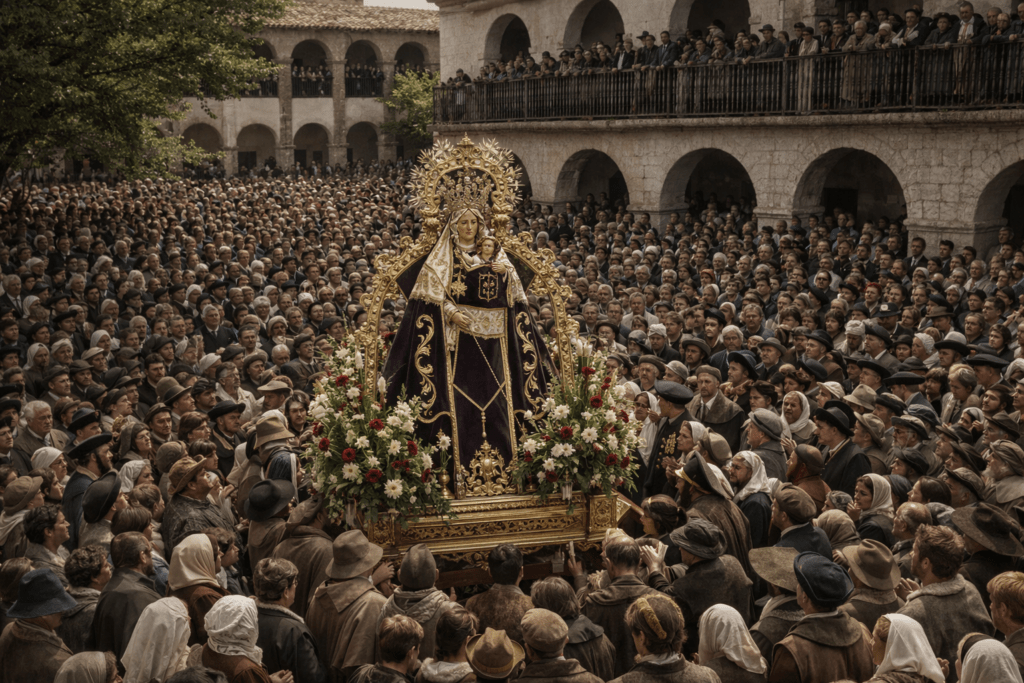
Hay fechas que no cambian la historia de un reino, pero sí ayudan a entender la vida real de una tierra. En la Sierra de Alcaraz, una de esas fechas es el 24 de marzo. La historiografía local sitúa en ese día de 1567 una licencia real de Felipe II para que el concejo de Alcaraz pudiera costear un vestido de oro y plata para la Virgen de Cortes. Visto deprisa, podría parecer un detalle menor. Sin embargo, cuando se mira con calma, habla de algo mucho más grande: de la importancia de Cortes, del peso de Alcaraz en la organización del territorio y de la manera en que los pueblos de la sierra compartieron caminos, devociones y memoria durante siglos.
Una fecha pequeña, una historia grande
No estamos ante una gran batalla ni ante una fecha de manual escolar. Precisamente por eso tiene interés. La historia de los pueblos no siempre se conserva en hechos espectaculares. Muchas veces aparece en gestos concretos: una autorización, una ofrenda, una obra, una procesión, un gasto que revela qué lugares importaban de verdad y qué símbolos reunían a la gente.
En el caso de Cortes, además, no hablamos de una ermita cualquiera. La devoción a la Virgen de Cortes hunde sus raíces en época medieval y el santuario quedó ligado muy pronto a la historia religiosa y social de esta parte de la sierra. Con el paso del tiempo se convirtió en un lugar de peregrinación para gentes de muchos pueblos de alrededor, no solo de Alcaraz, sino de un espacio comarcal más amplio que hoy seguimos reconociendo como propio.
Cortes como centro de una comarca
Ahí está una de las claves del artículo: Cortes no se entiende solo como un templo. Se entiende como un centro de reunión, como un punto de referencia y como una pieza de una geografía humana compartida. Durante siglos, venir hasta aquí no era únicamente un acto religioso. También significaba recorrer caminos conocidos, coincidir con vecinos de otros lugares, intercambiar noticias, reforzar vínculos y participar de un calendario que muchas aldeas sentían como suyo.
Para entender mejor ese mundo conviene recordar el papel de Alcaraz. Tras la conquista cristiana del siglo XIII, la ciudad recibió un marco jurídico que ayudó a ordenar poblamiento, términos, aprovechamientos y vida concejil. Ese proceso no solo afectó a la ciudad principal: configuró toda una tierra con aldeas dependientes, rutas, montes y espacios de relación. Vianos, como otros núcleos del entorno, formó parte históricamente de esa lógica territorial.
Una sierra conectada por caminos, costumbres y memoria
Visto desde hoy, esto puede parecer abstracto. Pero en realidad era algo muy concreto. Significaba compartir un centro de referencia. Significaba que la vida cotidiana de los pueblos no estaba aislada, sino enlazada por asuntos de jurisdicción, economía, caminos y devoción. La sierra no funcionaba como una suma de puntos sueltos, sino como una red. Y en esa red, Cortes ocupaba un lugar especial.
Por eso una fecha aparentemente pequeña puede decir tanto. Si la historiografía local recuerda ese momento del siglo XVI en relación con la Virgen de Cortes, no es solo por el dato en sí, sino por lo que revela: que el santuario tenía un peso suficiente como para movilizar recursos, atención y memoria. Cuando una comunidad invierte en sus símbolos, está diciendo algo sobre sí misma. Está marcando qué considera importante, qué protege y qué transmite a las generaciones siguientes.
Qué nos dice esta historia desde Vianos
Mirado desde Vianos, el asunto deja de ser una historia ajena. Al contrario: ayuda a entender mejor el tipo de territorio del que forma parte el pueblo. La historia local de Vianos encaja dentro de esa tierra de Alcaraz, con una economía de base agroganadera y con formas de movilidad que enlazaban aldeas, ventas, heredamientos y espacios religiosos. Incluso en época moderna se percibe una sierra conectada y recorrida, en la que vecinos y viajeros mantenían vivos esos caminos y esas relaciones comarcales.
Eso ayuda a imaginar mejor el paisaje humano de entonces. No una sierra quieta y cerrada, sino una sierra recorrida. Una sierra en la que el movimiento no tenía nada de turístico: era trabajo, promesa, obligación, fe, comercio y costumbre. Por esos mismos caminos que hoy vemos como carreteras secundarias o rutas tranquilas circularon durante siglos animales, carros, recados, viajeros y vecinos que sabían perfectamente dónde estaba Cortes y lo que significaba.
Mucho más que un lugar de culto
También por eso conviene no leer estas historias solo en clave religiosa. Cortes fue, desde luego, un lugar de devoción. Pero también fue un espacio de identidad comarcal. Allí se cruzaban la fe y la vida práctica, la solemnidad y la costumbre, lo espiritual y lo cotidiano. Esa mezcla explica muy bien cómo se han construido muchos paisajes históricos del interior: no solo con piedra y documentos, sino con repeticiones colectivas, con calendarios compartidos y con lugares que ordenaban emocionalmente el territorio.
Hoy, cuando miramos la sierra desde el presente, tendemos a separar patrimonio, turismo, religión, paisaje y vida local como si fueran cosas distintas. En la historia rara vez lo fueron. Una ermita importante no era solo un edificio. Era un centro de gravedad. Un sitio que ayudaba a dar sentido al mapa. Un lugar al que se iba por muchos motivos a la vez.
Por qué estas fechas siguen importando
Tal vez por eso sigue teniendo fuerza detenerse en una fecha como esta. Porque detrás de esa referencia del siglo XVI no hay solo una anécdota. Hay una manera entera de entender la Sierra de Alcaraz. Y hay también una lección útil para leer pueblos como Vianos: su historia no se explica solo desde dentro, sino también desde las relaciones que mantuvo con Alcaraz, con Cortes y con ese mundo de caminos, aldeas y memoria compartida que dio forma a la comarca durante siglos.
A veces la historia local se conserva mejor en estos gestos discretos que en los grandes titulares. Una licencia, una ofrenda, una romería, una costumbre repetida año tras año. Cosas pequeñas, en apariencia. Pero cuando duran, terminan explicando un territorio entero.
Creado y editado por Miguel Delgado Paris ·
El Jardín de Vianos
👍 Si te gustó, déjanos un like en Facebook:
Facebook
24 March 1567 and the Virgin of Cortes: a small date that helps explain an entire region
Some dates do not change the history of a kingdom, yet they help explain the real life of a land. In the Sierra de Alcaraz, one of those dates is 24 March. Local historiography places on that day in 1567 a royal licence from Philip II allowing the council of Alcaraz to fund a gold-and-silver dress for the Virgin of Cortes. At first glance, it may seem a minor detail. In reality, it reveals something much larger: the importance of Cortes, the role of Alcaraz in organising the territory, and the way the villages of the sierra shared roads, devotion and memory over the centuries.
A small date, a larger story
This is not a great battle or a textbook date. That is precisely why it matters. The history of small places is not always preserved in spectacular events. More often, it survives in concrete gestures: an authorisation, an offering, a work, a procession, an expense that reveals which places truly mattered and which symbols brought people together.
In the case of Cortes, we are not talking about just any shrine. Devotion to the Virgin of Cortes has medieval roots, and the sanctuary soon became linked to the religious and social history of this part of the sierra. Over time it became a place of pilgrimage for people from many nearby villages, not only from Alcaraz, but from a broader regional space that is still recognisable today.
Cortes as the centre of a region
That is one of the keys to understanding this story: Cortes is not only a temple. It is also a meeting point, a reference point and part of a shared human geography. For centuries, coming here was not simply a religious act. It also meant following familiar roads, meeting neighbours from other places, exchanging news, strengthening ties and taking part in a calendar that many villages felt was their own.
To understand that world better, it helps to remember the role of Alcaraz. After the Christian conquest in the 13th century, the town received a legal framework that helped organise settlement, boundaries, land use and municipal life. That process did not affect only the main town: it shaped an entire territory of dependent villages, routes, mountains and spaces of relationship. Vianos, like other nearby settlements, was historically part of that territorial logic.
A sierra connected by roads, customs and shared memory
Seen from today, this may sound abstract. In reality it was very concrete. It meant sharing a common centre of reference. It meant that village life was not isolated, but linked by matters of jurisdiction, economy, roads and devotion. The sierra did not function as a set of disconnected points, but as a network. And within that network, Cortes held a special place.
That is why a seemingly small date can say so much. If local historiography remembers that moment of the 16th century in connection with the Virgin of Cortes, it is not only because of the fact itself, but because of what it reveals: that the sanctuary had enough weight to mobilise resources, attention and memory. When a community invests in its symbols, it is saying something about itself. It is marking what it considers important, what it protects and what it passes on to the next generations.
What this story tells us from Vianos
Seen from Vianos, this stops being someone else’s story. On the contrary, it helps explain the kind of territory the village belongs to. The local history of Vianos fits within that land of Alcaraz, with an agro-pastoral economy and forms of mobility that linked hamlets, inns, estates and religious spaces. Even in the early modern period, the sierra appears as a connected and travelled landscape, where neighbours and travellers kept those roads and regional ties alive.
That helps us imagine the human landscape of the time more clearly. Not a still and closed mountain region, but a travelled one. A sierra in which movement had nothing tourist-like about it: it was work, promise, obligation, faith, trade and habit. Along the same routes that we now see as secondary roads or quiet drives, animals, carts, messages, travellers and neighbours moved for centuries, all of them knowing perfectly well where Cortes was and what it meant.
Much more than a place of worship
That is also why these stories should not be read only in religious terms. Cortes was, of course, a place of devotion. But it was also a space of regional identity. Faith and practical life, solemnity and habit, the spiritual and the everyday all met there. That combination explains very well how many inland historical landscapes were built: not only with stone and documents, but with repeated collective practices, shared calendars and places that gave emotional order to the territory.
Today, when we look at the sierra from the present, we tend to separate heritage, tourism, religion, landscape and local life as if they were different things. In history, they rarely were. An important shrine was not only a building. It was a centre of gravity. A place that helped make sense of the map. A destination people reached for many reasons at once.
Why these dates still matter
That may be why it is still worth pausing over a date like this. Because behind that 16th-century reference there is not only an anecdote. There is a whole way of understanding the Sierra de Alcaraz. And there is also a useful lesson for reading places like Vianos: their history cannot be explained only from within, but also through the relationships they maintained with Alcaraz, with Cortes and with that world of roads, villages and shared memory that shaped the region over centuries.
Local history is often preserved better in these discreet gestures than in grand headlines. A licence, an offering, a pilgrimage, a custom repeated year after year. Small things, in appearance. But when they endure, they end up explaining an entire territory.
Created and edited by Miguel Delgado Paris ·
El Jardín de Vianos
👍 If you enjoyed this, please leave us a like on Facebook:
Facebook