
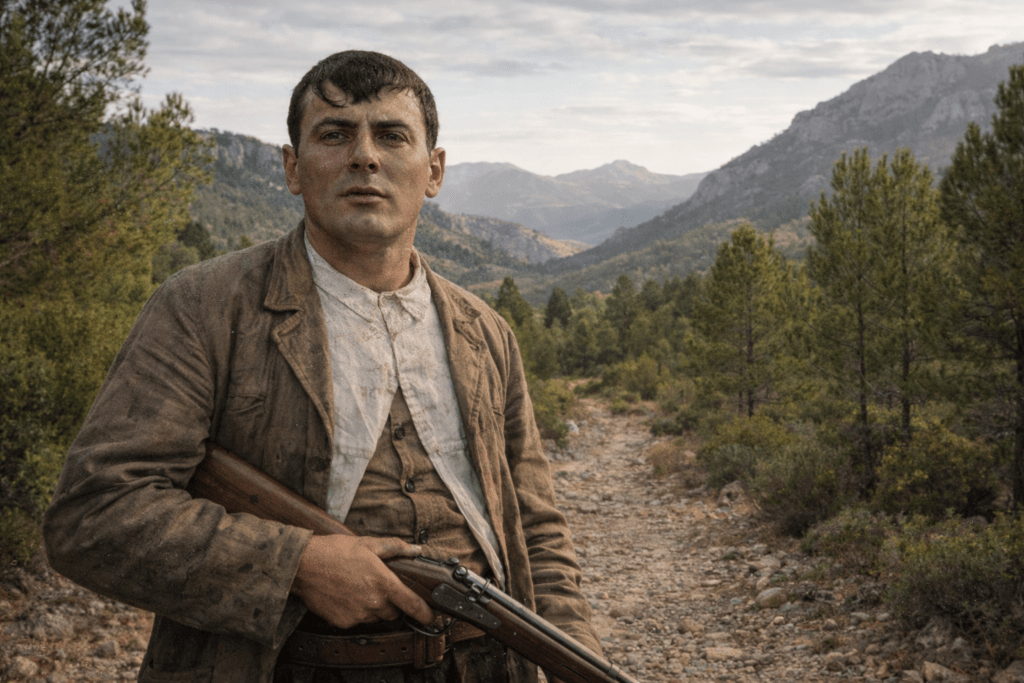
El Pernales en la Sierra de Alcaraz: historia completa, muerte y leyenda
Cuando se habla de El Pernales, muchas veces se repite antes la leyenda que la historia. Y sin embargo conviene empezar por lo básico: Francisco Ríos González no era un hombre de Vianos ni de Alcaraz. Nació en Estepa, en Sevilla, el 23 de julio de 1879, y creció en una Andalucía rural dura, pobre y profundamente desigual, el caldo de cultivo en el que el bandolerismo tardío todavía podía prender.
Su fama no nació porque fuera un forajido cualquiera, sino porque llegó en un momento en que el viejo mundo del bandolerismo estaba ya desapareciendo. Por eso su nombre quedó fijado como el de uno de los últimos grandes bandoleros andaluces. Robos, persecuciones, huidas y una cierta admiración popular entre parte del mundo campesino fueron agrandando su figura, hasta convertirlo en leyenda.
Ese contraste importa mucho. Porque la memoria popular tendió a convertirlo en una especie de justiciero montaraz, pero las fuentes locales que hoy lo recuerdan no ocultan que fue también un personaje violento y temido. Eso obliga a mirar su historia con la cabeza fría: ni héroe limpio ni simple caricatura.
Su relación con la Sierra de Alcaraz pertenece sobre todo al tramo final de su vida. Huyendo de la Guardia Civil, llegó a estas tierras acompañado por Antonio Jiménez Rodríguez, el Niño del Arahal. Ahí es donde la historia de un bandolero sevillano se cruza con la memoria de esta comarca albaceteña.
La muerte de El Pernales ocurrió el 31 de agosto de 1907, en el paraje de Las Morricas, junto al Arroyo del Tejo, en término de Villaverde de Guadalimar. Allí se produjo el tiroteo en el que cayeron muertos tanto Pernales como el Niño del Arahal. La autopsia posterior situó la muerte entre las dos y las tres de la tarde.
Después, los cuerpos fueron llevados primero a Villaverde, donde quedaron expuestos públicamente, y al día siguiente fueron trasladados a Alcaraz, donde se practicó la autopsia y se formalizó la identificación. Por eso Alcaraz quedó unida para siempre a esta historia, y por eso hoy su tumba sigue formando parte de la memoria local.
¿Y Vianos? Aquí conviene escribir con cuidado. No aparece un episodio local tan claramente documentado como el de Villaverde o Alcaraz. Lo prudente es hablar de Vianos como parte del mismo paisaje serrano y de la memoria actual del Camino del Pernales, que incluye las etapas Salobre–Vianos y Vianos–Alcaraz.
Así se entiende mejor su lugar en esta historia: no como escenario principal probado de su biografía, sino como parte real de la geografía donde el final de El Pernales se convirtió en relato comarcal.
Si has llegado hasta aquí y quieres añadir una versión familiar, una matización o simplemente tu opinión, vuelve a este post y déjala en los comentarios.
Creado y editado por Miguel Delgado Paris ·
El Jardín de Vianos
👍 Si te gustó, déjanos un like en Facebook:
Facebook
El Pernales in the Sierra de Alcaraz: full story, death and legend
When people talk about El Pernales, they often repeat the legend before the history. But the first point matters: Francisco Ríos González was not from Vianos or Alcaraz. He was born in Estepa, in Seville, on 23 July 1879, in a hard rural world shaped by poverty, inequality and the final stage of Andalusian banditry.
His fame grew because he came at the very end of the old world of bandits. That is why he entered memory as one of the last great Andalusian outlaws. Robberies, escapes, pursuit and later oral storytelling all helped turn him into a legend.
That distinction matters. Popular memory often turned him into a rough avenger of the poor, but local historical accounts also describe a violent and feared man. So the honest approach is neither to glorify him nor to flatten him into a cliché.
His connection with the Sierra de Alcaraz belongs mainly to the final days of his life. Fleeing with Antonio Jiménez Rodríguez, the Niño del Arahal, he reached these mountains, and that is where the story of a Sevillian bandit became part of the memory of this area of Albacete.
His death happened on 31 August 1907, in Las Morricas, beside the Arroyo del Tejo, in the municipal area of Villaverde de Guadalimar. The gunfight that followed killed both Pernales and the Niño del Arahal. The later autopsy placed their deaths between two and three in the afternoon.
After that, the bodies were first taken to Villaverde, displayed publicly, and then moved to Alcaraz, where the autopsy and formal identification took place. That is why Alcaraz became permanently linked to the story and why the grave remains part of local memory today.
And what about Vianos? Caution is essential. There is no equally solid documented episode inside the town itself like the one in Villaverde or Alcaraz. The careful way to frame it is as part of the same mountain landscape and as part of the present-day Camino del Pernales, which includes the stages Salobre–Vianos and Vianos–Alcaraz.
That is the real place of Vianos in this story: not a proven central scene in his biography, but a true part of the mountain geography where his end became a regional legend.
If you know another local version, a family memory or simply want to leave your view, come back to this post and leave it in the comments.
Created and edited by Miguel Delgado Paris ·
El Jardín de Vianos
👍 If you enjoyed this, please leave us a like on Facebook:
Facebook